
Roadmap
Do we have more ideas to make Exceptional even better? Sure thing, plenty of ideas! There are still a number of features and improvements we wish to add to Exceptional. This page list these in random order, so this page is not really a classic roadmap. This means that the order in which the appear on this page is not necessarily the order in which these will be implemented.
Refine exception messages
The messages added to NullPointerExceptions include the name of variables, fields and/or methods. This in order to make it easy to understand where problem occurred in the code.
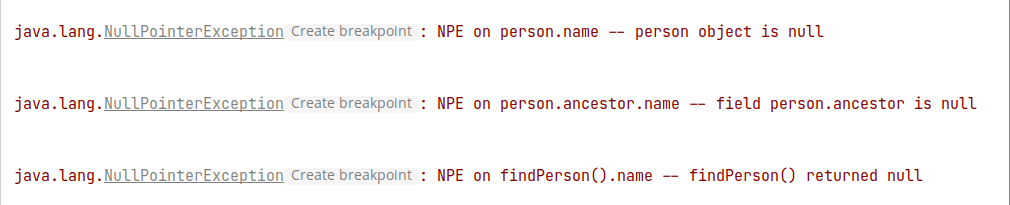
The current message can still be refined by distinguishing between the different operations. Although the current message is certainly correct it use the same format for all types of operations.

The refined exception message could look like as shown below. The example below is prototype which illustrates how the message differ depending on the step that produces the null reference.
Handle methods with try-catch-blocks
try-catch-blocks in methods introduces a some complexity in the analysis of the bytecode. The current version of Exceptional does not yet handle this reliably. We have therefore chosen to avoid release a version which can produce incorrect bytecode. Handling these case is a next step.
Optimize instrumentation
The current instrumentation policy is very paranoid. Any location which is even remotely susceptible of throwing a NullPointerException is instrumented. Although this is correct it still be a optimized to reduce the number of instrumented instructions while retaining the same coverage.
Extend list of known methods
Exceptional instruments the code handle the return value of methods. Indeed, Exceptional needs to guard the code in case a method returns a null value. We can reduce the number of instrumented instructions for methods (provided by the JDK and other popular libraries) which are known to never return null. These methods calls do not need to be instrumented.
Method parameters and array index in exception messages
As far as messages are concerned we could go one step further in the refinement of the messages. The expressions that produce the method arguments and array indexes could be added to the exception messages. A prototype is depicted below.
These expressions themselves can be rather large by themselves. Long exception messages may reduce the readability rather than increase it. A size constraint seems necessary here.

Handle array operations
In Java arrays are object too. A reference to an array can therefore potentially be null. We plan to add the necessary check for array access operations.